







Find, save and share Public Notices that affect you in the area.
Search the Public Notice Portal What is the Public Notice Portal?What is the Public Notice Portal?
The Public Notice Portal carries statutory public notices published in local newspapers and is the fastest and most effective way of finding out what is happening in YOUR neighbourhood.
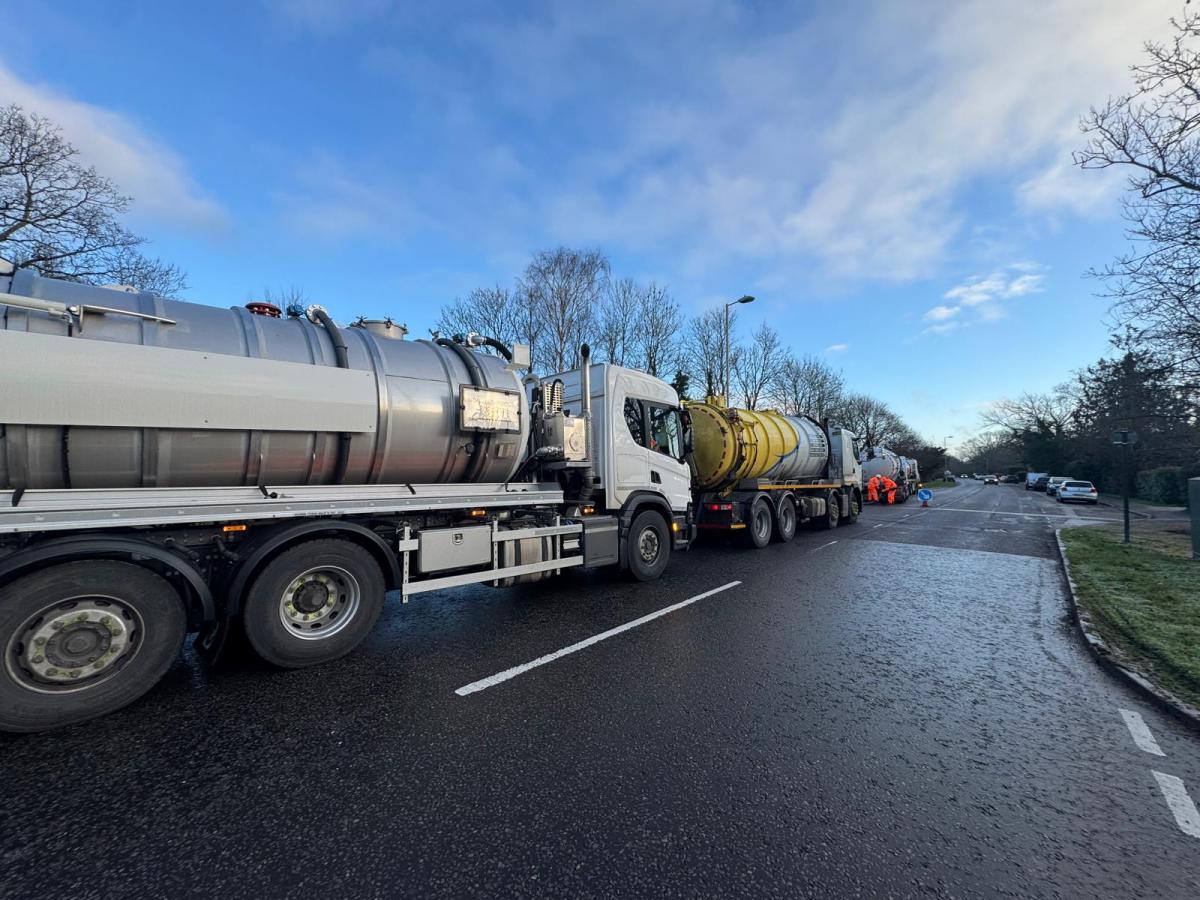
Search the Public Notice PortalRAW sewage has been discharged into rivers around Basingstoke for more than 1,200 hours in just six months - the equivalent of over 51 continuous days.
The shocking statistics come as a senior borough councillor accused successive governments of ignoring evidence that the area cannot cope with its existing homes, let alone tens of thousands more.
Data from sewagemap.co.uk, which tracks Thames Water's own Event Duration Monitoring figures, lays bare the scale of storm overflow discharges into the waterways that feed the River Loddon, which is one of England's rarest chalk stream systems, between October 2025 and March 2026.
The Silchester overflow (monitor CNTW.0737) alone ran for 1,238 hours, discharging raw and diluted sewage into Silchester Brook. At Mortimer, near Stratfield Saye, the overflow at TEMP.2783 discharged into Foudry Brook for 1,208 hours and 45 minutes.
At Sherfield-on-Loddon, the TEMP.2891 monitor recorded 323 hours and 45 minutes of overflow into Bow Brook, while the Basingstoke town overflow at CTCR.0875 ran for 310 hours and 15 minutes into a tributary of the Loddon. All four watercourses feed into the River Loddon, a protected chalk stream of rare ecological significance.
READ MORE
-
Woman threatens to dump dog poo bags at firm's offices over overflowing bins
-
Revealed: The best and worst Basingstoke neighbourhoods for access to green space
-
Water firm using 'baby hedgehogs' to remove wet wipes from sewers
-
'Not enough drinking water' Thousands of new homes face delays over water supply fear

The figures show that discharge events were almost absent in October and November 2025, before dramatically accelerating through January and February 2026.
Independent borough councillor Onnalee Cubitt, who represents Basing and Upton Grey, has been raising concerns about the borough's water capacity since 2008. She said the situation exposed a systemic failure she has been warning about for nearly two decades.
"None of the things promised by water companies since 2016 have been delivered," she said. "15,000 houses have been built, but none of the commitments made has been delivered. The pipe needed to meet the needs for the 15,000 already built is not here, but now they want to build 21,000 more."
Her anger extends to central government. "The national government is loathsome," she said. "I despise government of all colours for letting this continue."
The scale of that looming expansion is not in dispute. Under the government's revised planning rules introduced in late 2024, Basingstoke and Deane Borough Council is required to deliver approximately 21,000 new homes by 2040 - a figure that forced the council to plan for 6,000 more homes than it had anticipated. The government's standard methodology now sets a local housing need of 1,142 dwellings per annum, up sharply from 828 the year before.

Cllr Cubitt reserved particular anger for the planning process itself, in which she says elected representatives are being asked to vote on decisions without adequate evidence.
She said: "Officers say the only question they are allowed to ask is: 'Is there a technological need?' But the real question we need to ask is: can we meet the need? When we go into full council, it is on our heads if the evidence we evaluated is not up to scratch. The historical evidence has been rubbish. We are asking the right questions. We are seeking the truth."
Basingstoke and Deane sits within a designated area of serious water stress. A formal submission to the council's ongoing Local Plan consultation stated this year: "This is a severely water-stressed area. Currently, the rivers are over-abstracted."
Natural England has flagged concerns about the impact of ongoing abstraction on Greywell Fen and the chalk stream network, while South East Water has warned that parts of the proposed growth may exceed current supply assumptions.
Cllr Cubitt also pointed to a water cycle study commissioned by the council in 2007, claiming it warned the borough could not support more housebuilding because of water constraints, and that the document was not made fully available until 2011.
However, the council disputes this. A spokesperson confirmed that Phase 1 of the Water Cycle Study was submitted to a public examination in March 2007 and that the council is "not aware of why any of the study would have been redacted."
The council said the study concluded that "strategic development at Basingstoke of a scale tested through the three scenarios is not constrained by flood risk or water resource issues".

The council also confirmed that between 2016/17 and 2024/25, a net total of 8,570 new homes were built in the borough.
Despite challenging some of Cllr Cubitt's specific claims, cabinet member for strategic planning and infrastructure, Cllr Andy Konieczko, acknowledged serious concerns about whether infrastructure can support the level of growth now being demanded.
He said: "The updated study identified potential issues with South East Water’s ability to provide a resilient supply of fresh water, for drinking, washing and flushing toilets, to allow for the building of new homes over the next two decades.
"Following further clarification from South East Water during the consultation on the draft Local Plan, we’ve been working closely over the past few months with South East Water, the Environment Agency, Natural England and the government to fully understand what the water supply-related issues mean for our borough and the Local Plan.
"Our position from the start is that the significant rise in housing numbers imposed on our borough by the government must be supported with adequate strategic and local infrastructure. This vital additional work is required to properly address these issues.
"The cabinet strongly believes that we need to have clear assurances that the homes we are being asked to plan for will have sufficient infrastructure in place to serve them."
Thames Water, meanwhile, was rated a "one-star poor-performing company" — the lowest possible rating — by the Environment Agency in its 2024 annual environmental performance report.

The company has promised to cut total discharge duration by 50 per cent by 2030 compared to 2020 levels.
The company was also fined following a pollution incident in the River Loddon earlier this year.
"I can smell a massive rat," Cllr Cubitt said. "The government tells us to build, but it's up to us to determine the evidence, so the borough council bears the blame."
South East Water’s head of water resources, Nick Price, said: “We update our Water Resources Management Plan (WRMP) every five years. We have started the process of developing the next plan which will be published in 2029.
“We will be using the latest housing figures when creating the plan to accommodate any planned additional properties as we have a duty to connect new domestic properties to the water supply network as they are built.
“We are not a statutory consultee in planning applications, but we do review planning applications like this across our supply area, because additional properties could increase water demand beyond what we have planned for in our 2024 WRMP.
“We are committed to working with all stakeholders to find a way forward and we’ll continue to work with local councils to understand any emerging new housing requirements and if they can be accommodated within our existing supply-demand forecasts prior to the development of our next WRMP.
“In the shorter term, our priority continues to be to reduce leakage, improve water efficiency, and we have started work upgrading meters across our network in preparation for smart meter technology.”
Thames Water and DEFRA have been approached for comment.


Share